
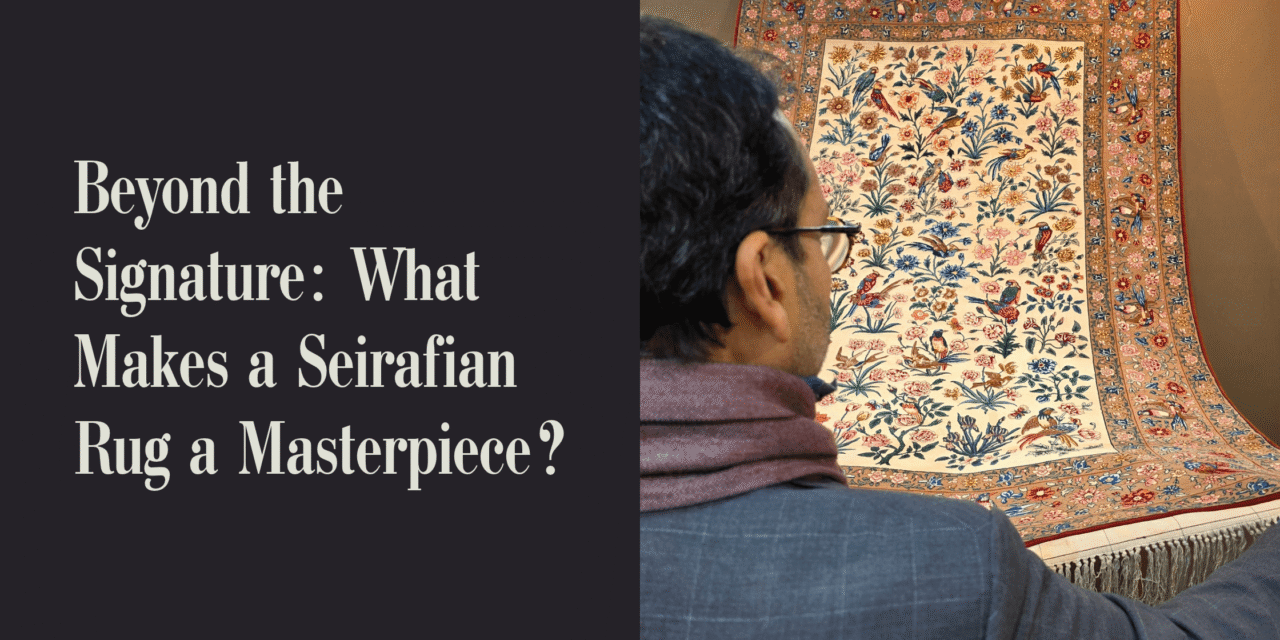
What Makes a Seirafian Rug Special? A Collector’s Guide to Fine Persian Carpets
There is something about a fine Seirafian rug that makes you want to look twice. At first, it might be the colours. Then you begin to notice the drawing: a flower with an unusually delicate outline, a border that turns neatly around a corner, or a small figure rendered with surprising precision. What appears effortless from a distance becomes more interesting as you get closer.
The Seirafian name is familiar to many collectors of Persian carpets. Yet knowing the name and understanding the work are two different things. Two Seirafian rugs may both be beautifully woven and carry recognizable signatures. That does not necessarily make them equally accomplished, rare or desirable. So what should we actually look for?
What Makes a Seirafian Rug Special?
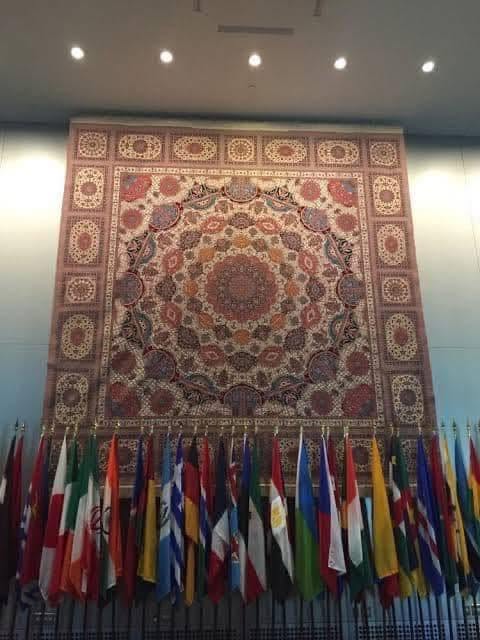
Seirafian rugs are fine hand-knotted Persian carpets associated with the Seirafian family workshops of Isfahan, Iran. The finest examples are admired for their precise weaving, carefully balanced designs, refined wool and silk materials, and distinctive artistic character. However, their quality cannot be established by knot density or a woven signature alone. The composition, workmanship, condition and attribution of each individual carpet matter just as much.
To understand what sets an exceptional Seirafian apart, it helps to look at the family behind the name and, more importantly, at the carpets themselves.
One Family Name, Many Artistic Approaches
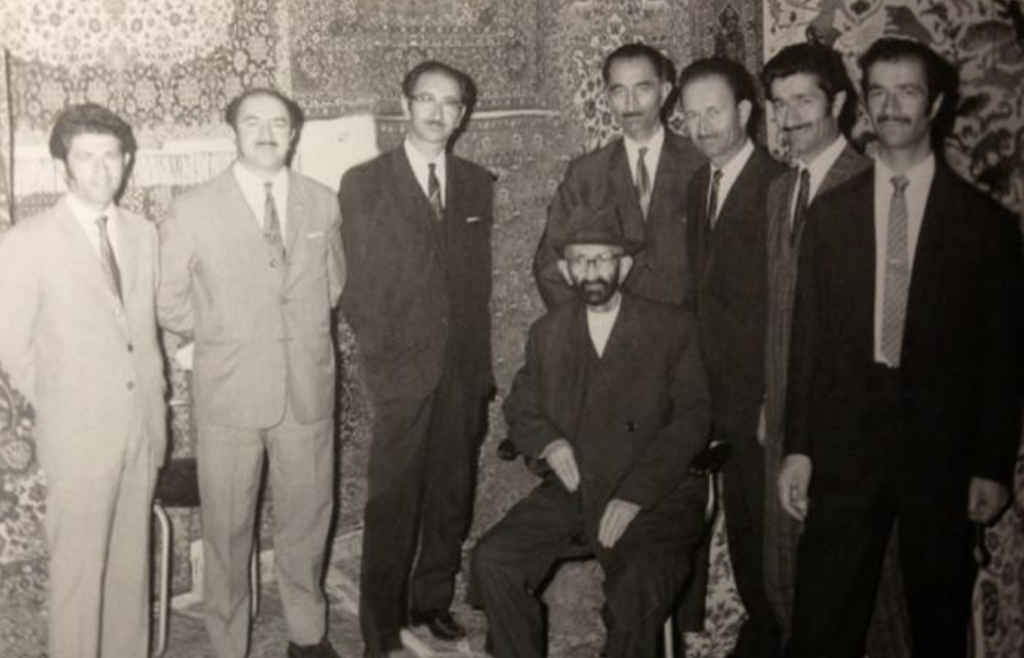
Seirafian Family
The Seirafian story began in Isfahan around 1940, when Haj Agha Reza Seirafian, a banker and established carpet enthusiast, developed the workshop tradition that would bring his family international recognition. He understood that producing an outstanding carpet required more than fine wool and experienced hands. Designers, weavers and materials all had to work together. The result was a workshop approach that placed considerable importance on both technical precision and artistic design.
The family enterprise expanded as his children entered the carpet business, with several developing their own workshops. This is an important distinction, particularly for anyone interested in collecting signed Seirafian rugs.
Mohammad Seirafian became known for ambitious works, including elaborate pictorial compositions. Sadegh Seirafian explored a particularly wide range of subjects, from traditional floral designs to hunting scenes and figurative carpets. Mohammad-Ali Seirafian, meanwhile, was especially associated with classical medallion designs and restrained, harmonious colour palettes.
Their work shared a family tradition, but not necessarily the same artistic direction. The differences can be subtle. One workshop might favour a quiet classical composition, while another might attempt something far more elaborate. For collectors, those individual characteristics can be as interesting as the family name itself.
Is a Higher Knot Count Always Better?
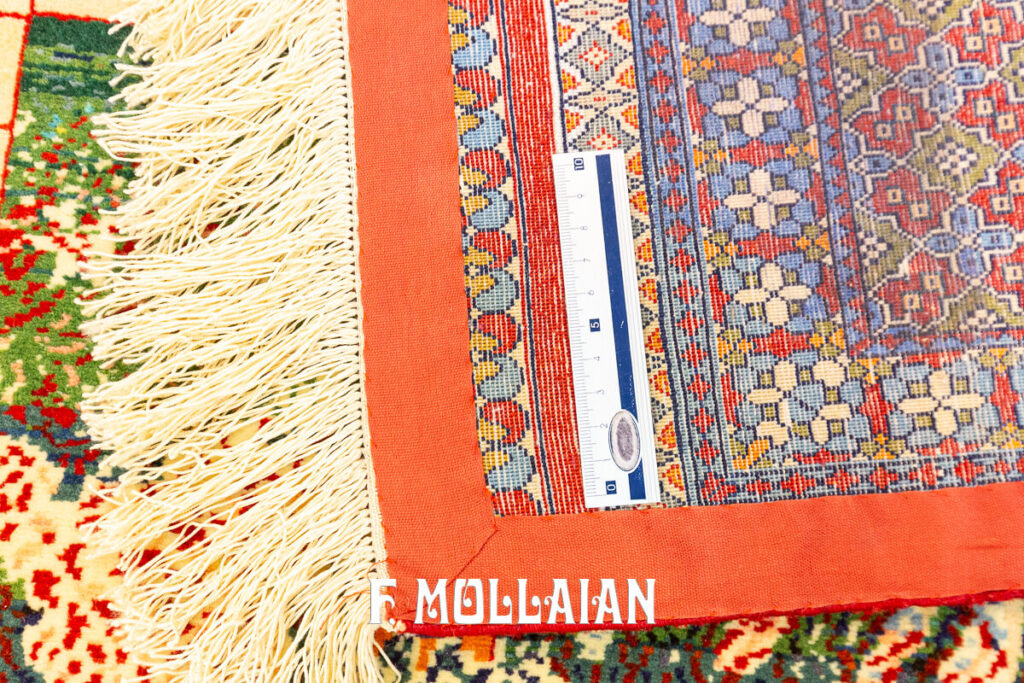
Knot Count – Seirafian Rug
When discussing fine Persian rugs, knot density almost always enters the conversation. It is an understandable point of interest. A finer weave allows the designer to produce smaller details, smoother curves and more complex arrangements of colour.
Some documented Seirafian carpets have exceptionally high knot densities. Christie’s, for example, has catalogued a signed Sadegh Seirafian carpet with approximately 11 by 11 knots per square centimetre. That is an impressive technical achievement. But does it automatically make the carpet a masterpiece? Not necessarily.
Imagine two drawings made with equally precise pencils. One may still be more balanced, expressive or visually interesting than the other. The same principle applies to weaving. A very fine knot structure gives the designer and weaver more possibilities, but the artistic result depends on how those possibilities are used.
Look at a floral border, for example. A beautifully drawn vine should move naturally through the design. Its leaves and flowers should feel connected rather than crowded together. When the border reaches a corner, the pattern needs to turn without losing its visual rhythm. These are details that can easily go unnoticed, yet they are precisely the kinds of decisions that distinguish an exceptionally designed carpet from one that is simply very finely woven.
The same applies to colour. In some fine Isfahan carpets, subtle differences between neighbouring shades create depth without relying on dramatic contrast. A flower may seem almost three-dimensional because of a few carefully arranged tones. Technical precision makes such effects possible. Artistic judgment makes them convincing.
Technical reference: Christie’s – Signed Sadegh Seirafian Isfahan Rug.
How Can You Recognize Exceptional Seirafian Craftsmanship?
A photograph can tell us a great deal about a carpet’s design, but it cannot replace a proper physical examination. Still, there are several details worth looking for when studying a fine Seirafian.
Start with the Overall Composition
Before examining the signature or counting knots, look at the carpet as a complete image. Is the design balanced? Does the central field relate naturally to the border? Are the colours working together? A successful composition usually feels coherent even before its smaller details become visible.
Follow the Curves
Curved lines are particularly revealing. In a hand-knotted carpet, the weaver cannot create a continuous brushstroke. Every curve is formed through a sequence of individual knots. The more complex the drawing, the more carefully those knots must be arranged.
Fine Seirafian carpets are often admired for the remarkably controlled treatment of floral stems, arabesques and other curved elements.
Look Closely at the Corners
The border corners are easy to overlook, but they can reveal how thoughtfully a pattern was designed. A well-resolved corner preserves the visual flow of the border. A weaker design may look interrupted or compressed.
Examine the Reverse
When it is safe to handle the carpet, the back provides useful information about its construction. The knotting should be examined alongside the materials, foundation, pile and overall condition. But remember that even a remarkably fine weave does not, by itself, prove a Seirafian attribution. The real interest lies in how the craftsmanship supports the design.
What Does a Seirafian Signature Actually Mean?
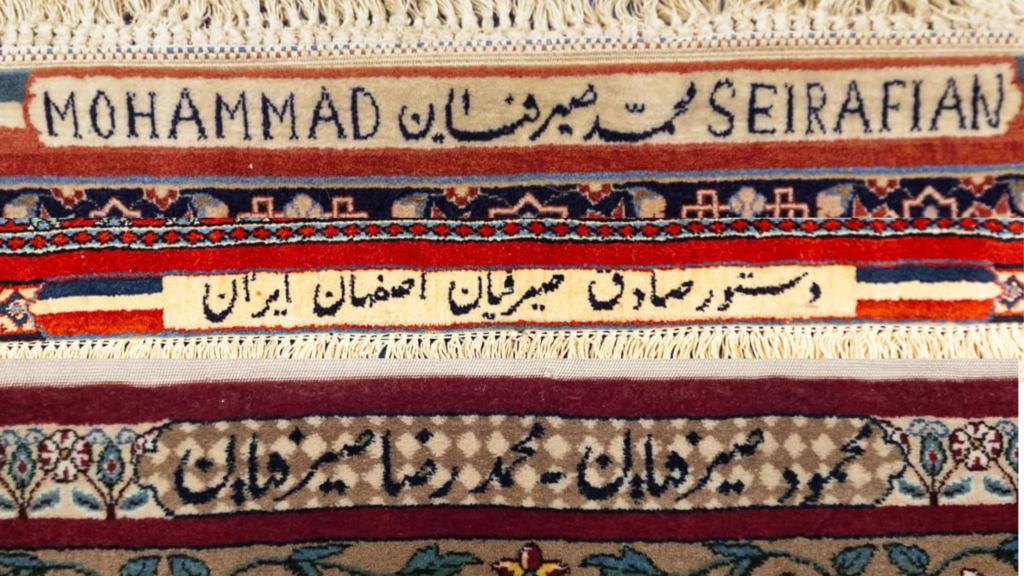
Seirafian Signatures
A woven signature is one of the most recognizable features associated with Seirafian carpets. In many examples, it appears within a small decorative panel near one end of the rug. Depending on the workshop and production period, the inscription may include the family name, an individual’s name, the city of Isfahan, Iran or additional lettering.
The signature can tell us something about the carpet’s origin and workshop association. However, it is worth asking what the inscription actually represents.
A fine Persian carpet was rarely the work of a single person. The finished piece could involve a designer, dyers, material suppliers, workshop supervisors and several weavers. A name woven into the carpet may therefore identify the workshop or person responsible for commissioning the production rather than the individual who tied every knot.
The Interesting Case of Sadegh Seirafian
Some Sadegh Seirafian carpets include the Persian word Dastur, meaning an order or commission. One inscription documented by Christie’s translates as: “Order of Sadegh Seirafian of Isfahan, Iran.” Other Seirafian inscriptions contain the word Farsh, meaning carpet.
These variations may help specialists investigate the workshop and possible production period, although they should never be treated as definitive dating evidence.
And there is another consideration. Because Seirafian carpets became highly desirable, some signatures were copied. This means that identifying an authentic Seirafian rug requires much more than finding a familiar name. The materials, construction, design, condition, provenance and inscription should all be considered together. For particularly important pieces, a specialist assessment may be necessary.
A signature is valuable evidence. It is not a substitute for examining the carpet.
Reference: Christie’s – Sadegh Seirafian Carpet.
When a Persian Rug Becomes a Painting
Not every Seirafian carpet follows a traditional medallion or all-over floral design. Some are pictorial works, presenting figures, birds, hunting scenes and other recognizable subjects. These carpets are particularly interesting because they bring together two artistic traditions: textile weaving and pictorial representation.
Persian miniature painting provides one important reference point. In a painting, an artist can describe a face, a garment or the movement of an animal with a few brushstrokes. In a carpet, the same effect has to be planned and executed through individual knots and changes of colour.
Think of the challenge of creating a bird’s feathers or the folds of a robe. The designer must decide which details are essential, how to simplify the image when necessary and how to preserve its character within a woven structure.
On smaller carpets, these challenges can be even greater. A complex subject must remain readable without becoming visually crowded. Some of the most admired Seirafian pictorial carpets demonstrate just how far this technique can be developed.
The result is more than a decorative pattern. It is a textile that invites the viewer to discover a scene, recognize a subject or explore a visual story.
Three Seirafian Carpets from the Mollaian Private Collection
Historical accounts and auction catalogues help us understand the Seirafian tradition. Individual carpets, however, give us something more immediate to study.
The Mollaian Rugs private collection includes three documented Seirafian examples, each with a different design or inscription. They offer an interesting opportunity to compare floral symbolism, pictorial weaving and workshop identity.
The following details are taken from Mollaian’s published catalogue records. Dates and attributions are presented as catalogue information rather than the results of a new physical examination.
A Gol o Bolbol Seirafian: Flowers, Birds and Persian Poetry
Collection no.: 482015 | Dimensions: 231 × 146 cm | Catalogued: circa 1940
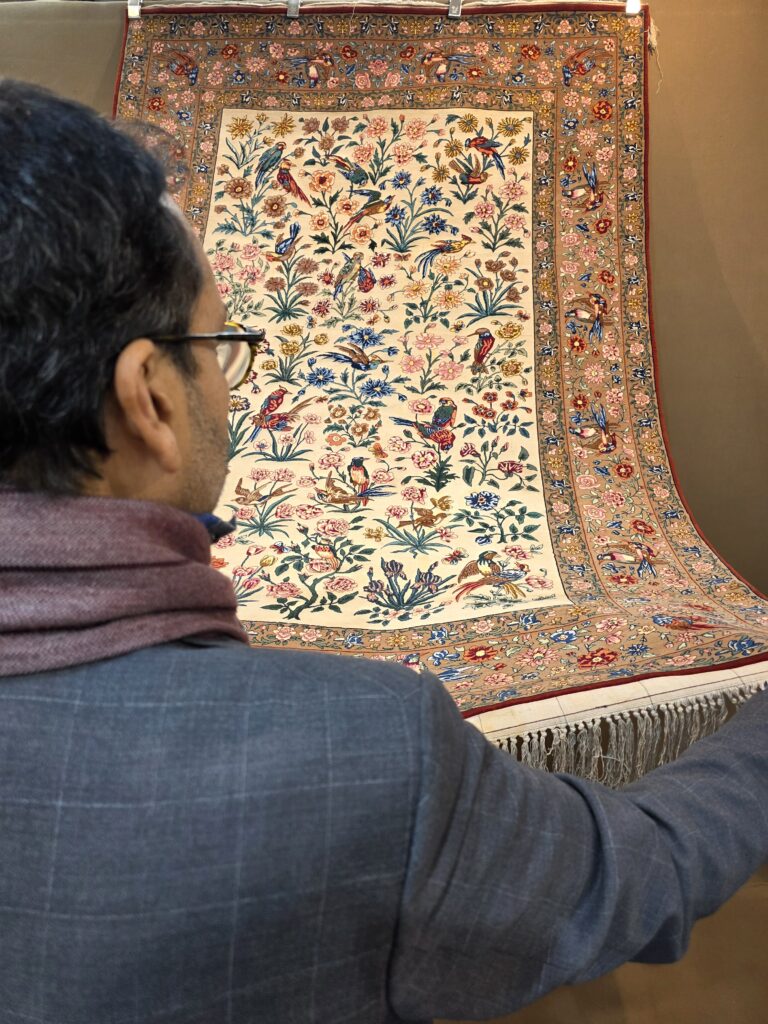
The Gol o Bol Bol Seirafian rug is a beautiful example of traditional Persian rug craftsmanship, distinguished by its intricate design, rich colours and exceptional attention to detail.Handwoven by skilled artisans, this rug showcases the artistic heritage of the Seirafian family of Isfahan, renowned for producing some of Iran’s finest Persian carpets. Its elaborate patterns, harmonious colour palette and fine detailing reflect a tradition of elegance, precision and timeless artistry.
View the Seirafian Gol o Bolbol Rug in Mollaian’s Collection
The first example is a Seirafian rug catalogued with a Gol o Bolbol design. Gol o Bolbol translates as Flower and Nightingale, a subject closely connected with Persian poetry and art.
The nightingale and the rose are familiar figures in Persian literary traditions, often associated with love, beauty and longing. Their relationship has inspired poets, painters and decorative artists across generations.
In a carpet, this imagery introduces an interesting challenge. Natural forms such as birds, flowers and curved stems must be translated into a carefully structured woven design.
The Mollaian example measures 231 × 146 cm and is catalogued with a kork wool pile on a silk warp and weft. Its recorded inscription reads, “Woven in Iran, Isfahan, Seyrafian.”
The catalogue dates the piece to approximately 1940, around the early development of the family workshop tradition. As with other historical workshop attributions, that dating deserves careful documentation.
What makes this carpet especially relevant to the discussion is its subject. Rather than looking at its flowers and birds purely as decoration, we can understand them within a wider Persian artistic tradition. The design offers a connection between textile craftsmanship and the cultural language of poetry.
For collectors, that relationship can make a carpet interesting beyond its age, materials or signature.
A Sadegh Seirafian Pictorial Rug: What the Inscription Reveals
Collection no.: 15058877 | Dimensions: 145 × 95 cm | Catalogued: circa 1950–1970
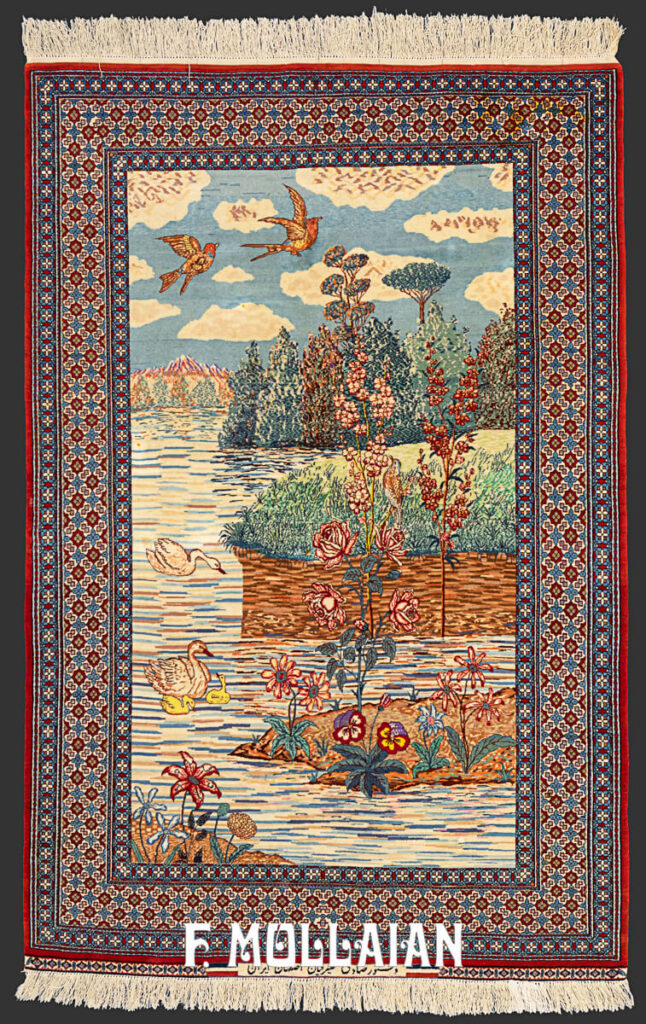
View the Signed Sadegh Seirafian Pictorial Rug
The second carpet introduces another side of Seirafian production. This smaller pictorial rug is catalogued as a figurative work associated with Sadegh Seirafian.
Its materials are recorded as kork wool pile with silk warp and weft, and its inscription is particularly interesting:
“Ordered By Sadegh Seyrafian, Isfahan, Iran.”
The wording connects the carpet to the commissioning tradition discussed earlier. Rather than simply treating the inscription as a mark of prestige, it is useful to consider what it tells us about the organization of workshop production.
The rug’s relatively compact dimensions are another point of interest. At 145 × 95 cm, a pictorial composition has limited space in which to communicate its subject. The designer must consider the relationship between recognizable details, colour and the overall arrangement.
This is a useful example for understanding why pictorial Seirafian carpets deserve attention as individual artistic works.
The important questions go beyond whether a signature is present. How effectively does the design communicate its subject? How are the details organized? And how does the finished composition compare with other documented works from the same workshop?
Those questions can only be fully answered through close examination of the actual carpet, but they provide a much richer starting point than the signature alone.
Another Sadegh Seirafian: Similar Materials, a Different Individual Work
Collection no.: 988608 | Dimensions: 174 × 109 cm | Catalogued: circa 1950–1970
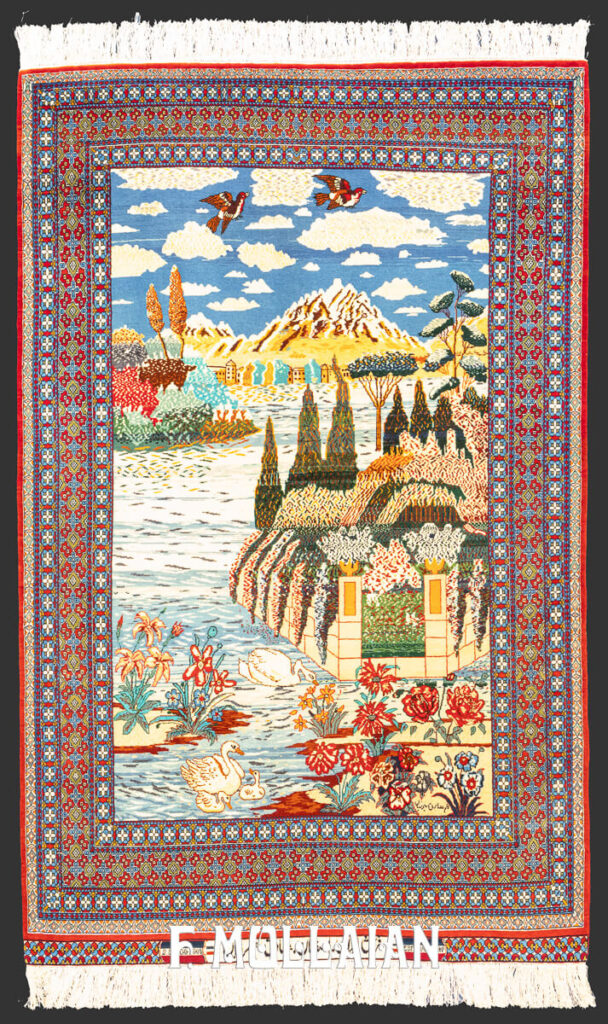
View the Second Sadegh Seirafian Pictorial Rug
The third example is another pictorial Isfahan rug associated with Sadegh Seirafian. Its dimensions are 174 × 109 cm, making it larger than the preceding piece.
The published catalogue again records kork wool pile with silk warp and weft, but the inscription differs:
“Iran’s Rug, Isfahan, Sadegh Seyrafian.”
This variation provides a useful reason to compare the two carpets. Inscription wording can vary between Seirafian workshop pieces, but it should not be used on its own to establish a precise date.
What we can say is that these two carpets are separately documented pictorial works with different dimensions and recorded signatures.
A side-by-side examination would allow us to compare how the designs occupy their respective fields, the treatment of smaller details and the relationship between pictorial imagery and surrounding borders.
The comparison also illustrates a broader point about collecting. Two rugs can share a producer’s name, similar materials and an approximate production period while still being very different artistic objects. It is those differences that make studying individual carpets worthwhile.
Together, these three Mollaian collection pieces demonstrate why the Seirafian name should encourage closer examination rather than replace it.
Are Seirafian Rugs Valuable?
Some Seirafian carpets are highly collectible, particularly exceptional examples associated with recognized family workshops. But there is no universal price for a signed Seirafian rug.
Collectors consider a combination of factors: the strength of the attribution, artistic quality, condition, rarity, provenance and evidence from comparable sales. The distinction between technical excellence and artistic merit remains important here.
A finely woven classical carpet and an elaborate pictorial example may appeal to different collectors. An unusual design may be desirable because of its individuality, while another carpet may attract attention because its history is especially well documented.
Condition can also make a substantial difference. Wear, fading, previous restoration and structural damage may affect how a carpet is valued. A professional condition report is particularly useful when considering an expensive or historically important example.
Actual market evidence is essential. Auction estimates, hammer prices and dealer asking prices represent different things. None should be used interchangeably.
Most importantly, a well-known signature is not a guarantee of future appreciation. A thoughtful collector looks for quality, authenticity and personal artistic interest before treating a carpet as a financial asset.
The useful question is not simply, “Are Seirafian rugs expensive?” It is, “What makes this particular Seirafian carpet worth collecting?”
What Should a Collector Look for Before Buying a Seirafian Rug?
When examining a Seirafian carpet, start with the design rather than the signature. Does the composition feel balanced? Are the colours convincing? Is the drawing precise throughout the carpet, including the smaller details and border corners?
Next, consider the construction and materials. The back of the rug, knotting, foundation and pile can provide valuable information, especially when examined by a knowledgeable specialist.
Then study the attribution. Can the inscription be read? Is there supporting provenance? Does the apparent period, design and construction fit the stated workshop association?
Finally, request information about condition and any restoration. No single detail answers every question. A reliable assessment develops from the evidence as a whole. And if the rug is especially rare or valuable, the cost of obtaining an independent expert opinion may be worthwhile.
Frequently Asked Questions About Seirafian Rugs
Are all Seirafian rugs made entirely from silk?
No. Many fine Seirafian carpets combine kork wool pile with a silk foundation. Some may include silk highlights, but the materials vary between individual carpets and workshops.
How can I identify an authentic Seirafian rug?
Examine its signature, construction, materials, design, condition and provenance together. Because signatures have been copied, the presence of a Seirafian name alone is insufficient proof of authenticity.
What is the difference between Sadegh and Mohammad Seirafian rugs?
Both are associated with important family workshops. Sadegh is particularly noted for his broad range of designs, while Mohammad produced distinguished classical and ambitious pictorial works. Individual carpets should be compared rather than assuming one workshop is always superior.
Are signed Seirafian rugs rare?
Some are uncommon, particularly examples from certain workshops or with unusual designs. Others were produced in greater numbers. A signature does not establish rarity by itself.
Why are Seirafian pictorial rugs interesting to collectors?
Pictorial carpets require designers and weavers to translate recognizable images into knotted textiles. Exceptional examples may demonstrate both advanced technical skill and artistic individuality.
Do Seirafian rugs increase in value?
Not necessarily. Some examples have achieved significant prices, but future values depend on condition, authenticity, collector demand and wider market circumstances. Appreciation should never be assumed.
A Seirafian Is Worth More Than a Quick Look
There is a temptation, when examining an important Persian carpet, to focus immediately on its famous name. With Seirafian rugs, that is understandable. The family’s reputation is well established, and many of its carpets represent exceptional achievements in Isfahan weaving.
But the name is only part of the story. The more rewarding details are often smaller: a carefully resolved corner, an unusually controlled curve, a well-composed pictorial scene or an inscription that reveals something about the workshop behind the piece.
The three Seirafian carpets documented in Mollaian’s private collection offer different ways of approaching these questions. The Gol o Bolbol rug connects weaving with Persian artistic symbolism. The two Sadegh-associated pictorial examples provide opportunities to explore workshop inscriptions, artistic individuality and the challenges of figurative design.
What they share is an invitation to look more carefully. A signature may draw our attention to a carpet. Understanding its artistry is what makes us stay.
Explore the Seirafian Rugs Collection at Mollaian Rugs and discover more about the tradition of Isfahan Persian carpets.
Sources and Further Reading
- Christie’s – An Isfahan Carpet Signed Sadegh Seirafian – Workshop history, technical characteristics and inscription translation.
- Christie’s – Signed Seirafian Isfahan Rug – Knotting, design characteristics and materials of fine Seirafian production.
- Mollaian Rugs private-collection catalogue records: 482015, 15058877 and 988608.


